Marketing Has a ‘Sameness Problem’
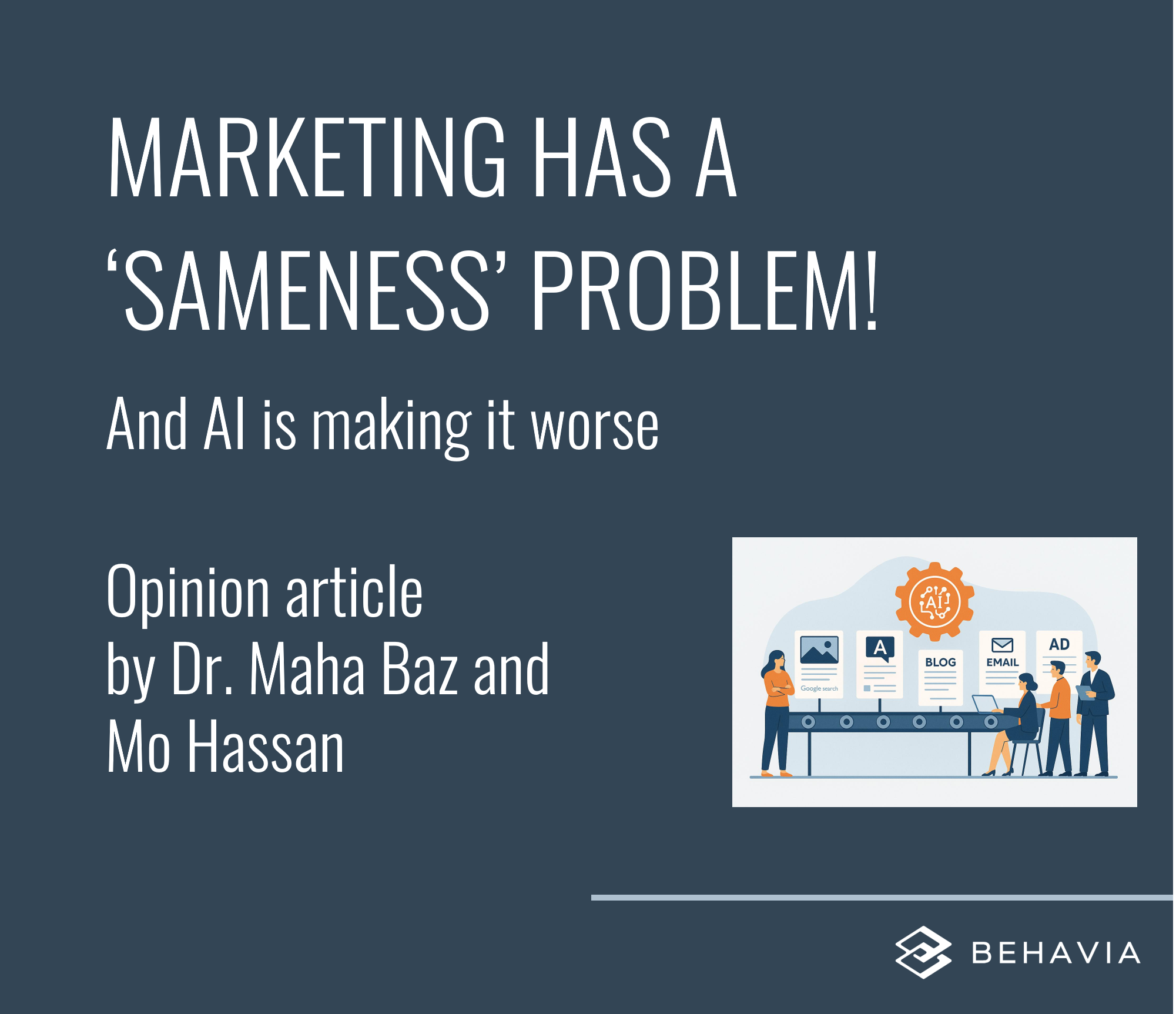
For decades, marketers have been striving to create campaigns that were effective, exciting, and connect with their audience. Today, with the increasing adoption of AI in marketing, brands are producing much more content than before, yet much of it feels remarkably similar.
Scroll through LinkedIn, Instagram, or TikTok and you start noticing the pattern. Communication across industries is converging toward similar visuals, similar tone, and similar messaging structure. Everyone seems to be using the same content formats, following the same trends, and chasing the same benchmarks. While AI has made content creation faster and more accessible, it is also contributing to a growing culture of ‘sameness’ that threatens one of marketing’s most valuable assets.
What is driving the ‘sameness’?
Generative AI tools are trained on vast amounts of existing content and generate responses based on patterns they have learned. By design, they gravitate toward the statistical ‘middle’; producing content that prioritizes probability. In other words, they tend toward the most likely answer rather than the most original one. Even when given different prompts, AI-generated outputs often converge on very similar structures, phrases, and ideas.
For example, researchers asked three groups of writers to create short stories: one group worked without AI, another received one AI-generated idea, and a third received five AI-generated ideas. While AI helped generate ideas, the stories became increasingly similar to one another as the amount of AI input increased, suggesting that AI can boost creativity at the individual level but reduce originality across a larger group.¹ As a result, many brands end up producing content that follows familiar structures, phrases, and ideas. We increasingly see the same expressions repeated across industries: “Unlock your potential”, “Transform your business”, “Elevate your experience”. These messages are polished and professional, but they are rarely distinctive.
The second factor is social media algorithms. Social media platforms reward content that already performs well. TikTok, Instagram, LinkedIn, and other platforms encourage users to adopt successful formats, trending sounds, and proven engagement tactics. That means that marketers may feel more inclined to imitate what is already working rather than experimenting with something new. The outcome is predictable: when everyone follows the same playbook, everyone starts looking alike.²
A third factor is an overreliance on benchmarking. Many organizations follow their competitors too closely. While competitor analyses are valuable, they can unintentionally encourage risk-averse decision-making. Teams see what competitors are doing, identify what appears successful, and replicate it.
The three factors combined create what could be called “safe marketing” – content that minimizes risk but also minimizes originality with neutral tone, trend-following visuals, generic positioning and minimal creative risks. And while “safe marketing” rarely attracts criticism, it rarely stands out.
Why this matters
Some may argue that sameness is not necessarily a problem if campaigns are generating results, but the issue goes beyond short-term engagement. The fundamental purpose of branding is to create recognition and shift preferences. To do that, brands must be distinct from one another. Research from NielsenIQ found that consumers could identify many AI-generated advertisements and perceived them as less engaging, more “confusing,” and more “boring” than traditionally produced ads.³ The study further suggested that AI-generated ads created weaker emotional and memory responses, making them less likely to leave a lasting impression.
Trust is also another major concern. According to the 2024 Edelman Trust Barometer, AI is at a “trust crossroads.” Globally, only 30% of respondents expressed enthusiasm for AI, while 35% rejected it, highlighting a significant gap between technological adoption and public confidence. Edelman argues that transparency and authenticity will be essential if organizations want people to trust AI-enabled experiences.⁴
If AI and social media algorithms push every brand toward the same language, ideas, and creative choices, the result may be efficiency but not differentiation. And, without differentiation, it becomes increasingly difficult to earn attention, build trust, or be remembered.
How can brands break free?
In our view, the solution is not to reject the use of AI. In fact, AI has become a valuable tool that can improve efficiency, speed, and productivity. The challenge is learning how to use it without sacrificing originality.
First, brands must focus on their unique point of view before they focus on content production. Many organizations ask, “What should we post?” before asking “What do we stand for?”, whereas distinctive marketing starts with a clear identity, strong opinions, and a recognizable voice. Therefore, AI can help scale those ideas, but it should not define them.
Second, companies need to place human judgment at the center of the creative process. The most memorable campaigns often emerge from human experiences, cultural insight, humor, emotion, and storytelling. These elements are difficult to generate authentically through automation alone. As a result, AI can draft content, but human teams should shape it, challenge it, and refine it until it reflects something uniquely theirs.
Third, marketers should optimize for memorability, not just short-term performance metrics. Not everything that generates immediate clicks builds a brand. Distinctive brands often succeed because they take creative risks, adopt unconventional perspectives, and resist following every trend. So, the most effective long-term strategy is not doing what everyone else is doing, instead, it is finding your uniqueness.
Finally, brands in the Arab region in particular have a powerful opportunity to stand out through cultural authenticity. As AI adoption accelerates across the Middle East, brands that incorporate local stories, dialects, traditions, and genuine cultural understanding will be far more memorable than those relying on generic global messaging.
Conclusion
Marketing’s biggest challenge today is not a shortage of content. It is a shortage of distinctiveness. AI is making it easier for brands to create content at scale, but scale alone does not create impact. When combined with trend-following behavior, benchmark obsession, and algorithm-driven platforms, AI tools can push brands toward uniformity. In a world flooded with polished, optimized, AI-assisted communication, the greatest competitive advantage may simply be sounding like yourself!
References
- Doshi, A. R., & Hauser, O. P. (2024). Generative AI enhances individual creativity but reduces the collective diversity of novel content. Science Advances, 10(28). https://doi.org/10.1126/sciadv.adn5290
- Melgarejo-Espinoza, R., Gonzales-Cruz, M., Chavez-Perez, J., & Iparraguirre-Villanueva, O. (2025). Impact of the TikTok algorithm on the effectiveness of marketing strategies: A study of consumer behavior and content preferences. International Journal of Advanced Computer Science and Applications, 16(2). https://thesai.org/Downloads/Volume16No2/Paper_15-Impact_of_the_TikTok_Algorithm.pdf
- (2024, December 12). NIQ research uncovers hidden consumer attitudes toward AI-generated ads. https://nielseniq.com/global/en/news-center/2024/niq-research-uncovers-hidden-consumer-attitudes-toward-ai-generated-ads/
- World Economic Forum. (2024, March 21). Technology’s tipping point: Why now is the time to earn trust in AI. https://www.weforum.org/stories/2024/03/technology-tipping-point-earn-trust-ai/