When Does Scarcity Lead to Conflict?
As the climate crisis intensifies, many fear that growing scarcity of resources such as water, arable land, or energy will inevitably fuel conflict. Already, we see tensions over carbon emissions between historically high-emitting countries and those playing catch-up, disputes over fish stocks and the regulation of the world’s fisheries, and increasing concerns about access to water and land in vulnerable regions. These examples suggest that scarce resources can become a source of geopolitical tension.
Yet, the relationship between scarcity and conflict is far less straightforward than these headlines might suggest. Empirical evidence on the causal link between scarcity and conflict is surprisingly mixed: Sometimes scarcity increases conflict, but in other cases it appears to reduce it. Why does scarcity sometimes ignite tensions, while at other times it seems to encourage restraint and cooperation?
The Spark: Asymmetry
Many high-profile conflicts over scarce open-access resources share a common feature: the actors involved are seldom equal. Consider international negotiations on climate change or fisheries. Disputes in these negotiations rarely arise between countries with comparable histories of resource use. Instead, they typically involve actors with very different past levels of extraction – those who have already taken a large share of the resource and those who are now seeking access. Not surprisingly, tensions emerge when the former try to close the cookie jar just as others are reaching for it.
From the perspective of those who have historically used less of the resource, restrictions may appear deeply unfair. Why should they limit their use when others have already benefited for decades? At the same time, those who have long relied on the resource may feel entitled to their existing share and see it as legitimate or even necessary. When scarcity forces these competing claims into the open, conflict can easily follow.
The Test: A Laboratory Experiment
We set out to test whether asymmetry was the missing link between scarcity and conflict. While contemplating a trip to COP29 in Baku, we remembered how messy these international negotiations can become. We needed a more controlled environment to study the underlying dynamics. An environment that would allow us to causally test whether even a small asymmetry in past resource use could spark conflict among otherwise similar individuals.
We turned to our university laboratory. There, we created a simple game in which student participants jointly managed a renewable resource in the form of a fish pond. In each round, participants could catch fish from the shared resource. They also had the option to destroy part of another participant’s catch, a behavior commonly used in experimental economics as a proxy for conflict and hostility. The more conflict emerged around the use of the shared resource, the more likely participants were to engage in such destructive actions. We then systematically varied two conditions: the scarcity of the resource and the inequality in past resource use.
We induced inequality in past resource use through a simple visual nudge. Participants initially observed only half of the pond, with the other half blackened out. Some saw one half of the pond with plenty of fish, while others saw only a few. The small difference shaped behavior: those who saw more fish tended to take larger initial extractions, while those who saw fewer were more restrained. In this sense, the experimental setup mirrors real-world dynamics. A history of resource-intensive economic growth has led some countries to perceive nature as plentiful and readily exploitable, while others have historically contributed far less to resource exploitation and emissions.
After the first round in the experiment, the veil of ignorance was lifted, and all participants could see the full pond. From that point on, everyone had complete information about the resource, just as we today have common knowledge of the planetary limits. This allowed us to observe how the initial asymmetry influenced subsequent behavior. In many ways, it reflects the current global situation, where the limits of natural resources are increasingly visible to all, even if past patterns of use remain deeply unequal.
The Result: When Scarcity Meets Asymmetry
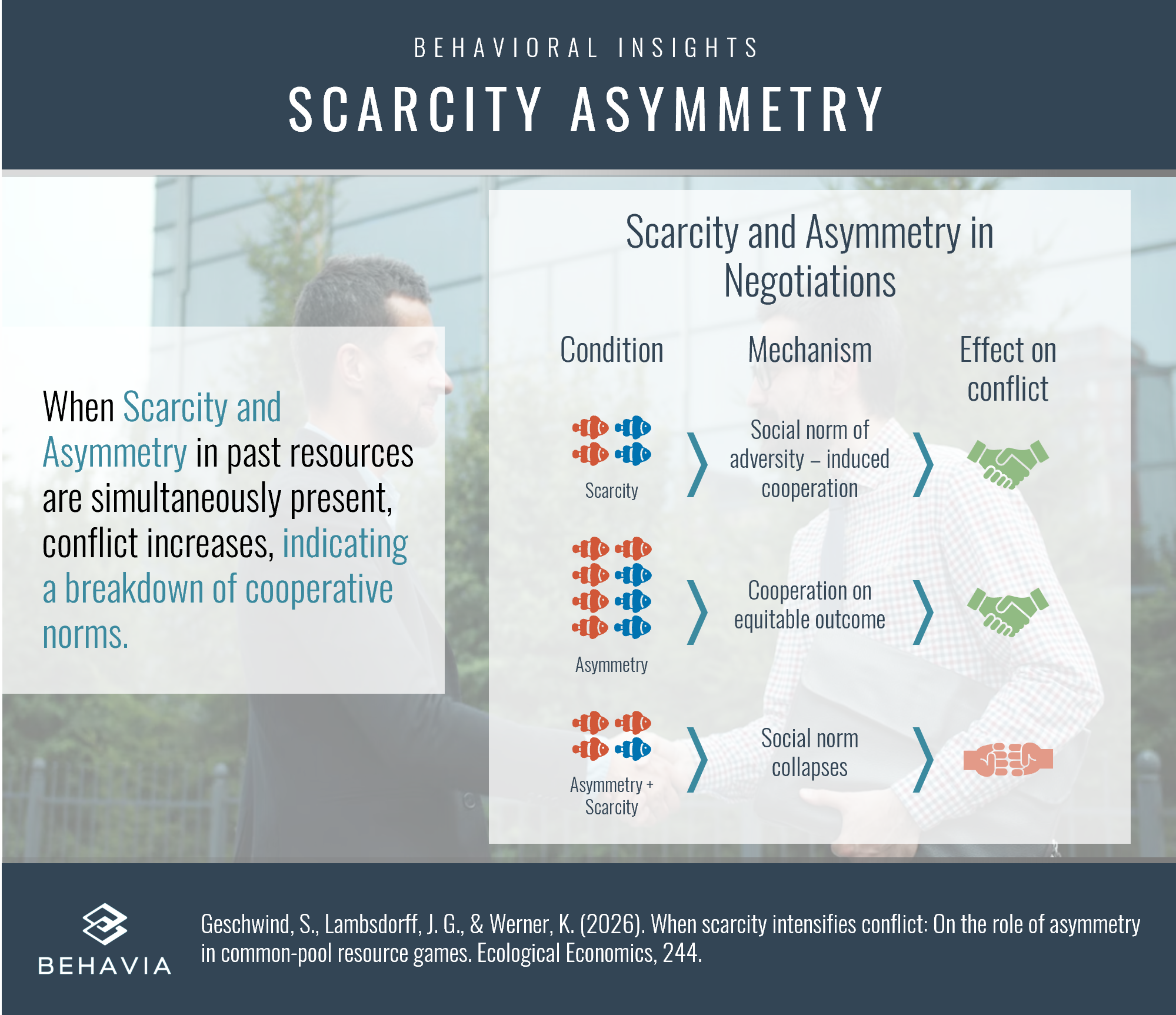
What we found fit remarkably well with the puzzle that set us on this journey. Scarcity alone did not increase conflict. Instead, it even had a mitigating effect on conflict. Participants engaged in fewer destructive actions against one another when the fish became scarce due to exogenously reduced reproduction. Scarcity seemed to activate a social norm, encouraging greater cooperation in the face of a shared crisis. Faced with the prospect of a shrinking resource, participants appeared less willing to harm others, even as competition over the remaining fish intensified.
Inequality in past resource use alone also did not entail more conflict. Instead, participants tended to coordinate their behavior to reduce the initial imbalance. Those who had taken more initially were more restrained in later rounds, while others increased their extraction. In effect, participants willingly shared the cookie jar to ensure that, by the end of the experiment, everyone received a fair share. This informal coordination helped keep destructive conflict at low levels.
Only when both factors, scarcity and inequality in past resource use, were present simultaneously did the dynamics change. The cooperative social norm appeared to break down, and conflict began to rise. Sustaining such norms of cooperation seemingly becomes more difficult when actors are in markedly different positions due to past resource use.
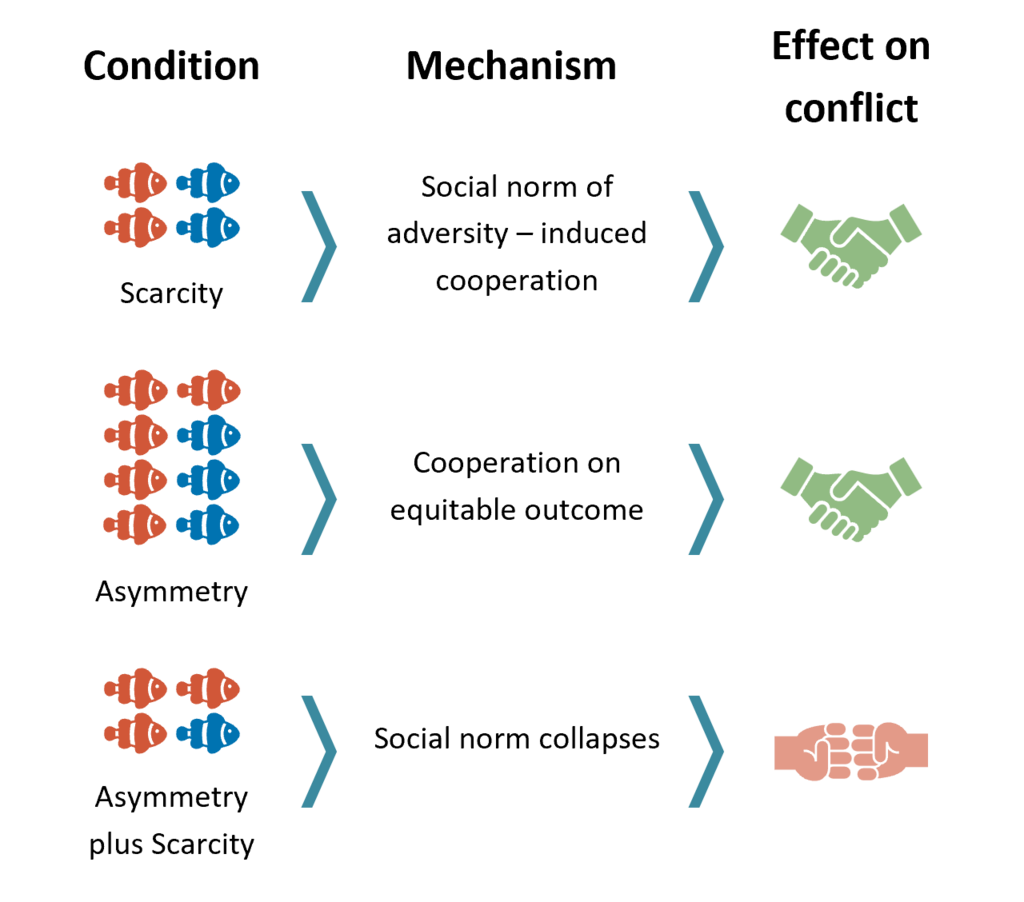
Figure: Effects of scarcity and asymmetry in past resource use on conflict behavior. Conflict is measured as the destruction of others’ catch. Scarcity and asymmetry individually each reduce destructive behavior, reflecting cooperation and coordination on equitable outcomes. However, when both factors are present simultaneously, conflict increases, indicating a breakdown of cooperative norms.
The Lesson: The Dangers of Asymmetry
Our laboratory experiment carries both hope and caution. On the hopeful side, human behavior appears to include cooperative tendencies that can help societies cope with scarcity. This finding echoes a broader strand of research showing that environmental stress can foster cooperation across many forms of life, from plants and animals to human societies. When facing shared adversity, collective restraint and coordination can emerge even without strong external enforcement.
Yet our findings also highlight how fragile these cooperative tendencies can be. Scarcity itself may not be the greatest danger. Instead, tensions arise when scarcity interacts with unequal histories of resource use. When some actors feel that others have already taken more than their fair share, the willingness to cooperate can quickly erode.
For international negotiations over global commons such as the climate or the oceans, this insight carries an important implication. Managing scarcity alone may not be enough. Policymakers may also need to explicitly address historical asymmetries in resource use. Emphasizing the egalitarian principles of the international system, acknowledging differences in past emissions or catches, and highlighting the shared nature of global commons may help sustain the cooperative norms that scarcity alone can sometimes produce. Framing negotiations in this way may give hope a chance to prevail over the dangers posed by the divide between those who have long had their hands in the cookie jar and those now seeking access.
Reference
This opinion piece is based on the following article:
- Geschwind, S., Lambsdorff, J. G., & Werner, K. (2026). When scarcity intensifies conflict: On the role of asymmetry in common-pool resource games. Ecological Economics, 244, 108963.