The Private Solution Trap
August 27, 2026
From climate change to pandemics, many of today’s most pressing challenges demand global cooperation. But individual incentives often prevent people from cooperating. Traditionally, researchers modeled these situations as a binary choice: Invest in a public solution, or not invest and free-ride on others’ efforts.
But a third option is increasingly available: Investing in private solutions that protect oneself while leaving the root problem unsolved. Imagine a world where people with enough money quietly opt out of public solutions – building higher walls, hiring private security, or relocating to safer areas rather than contributing to public security – while collective problems grow. When many people do this, a private solution trap can emerge: Public action slows, inequalities grow, and everyone ends up worse off. This raises an important question: when there is wealth inequality and private solutions exist, who still supports public solutions and who doesn’t? And do the origins of inequality – whether earned or due to luck – and cultural context influence this?
When the Exit Door Becomes a Trap
Private solutions exist in many domains. In healthcare, individuals buy private insurance rather than relying on public systems. In education, wealthy families choose private schools, withdrawing support for public alternatives. In security, gated communities and private security agencies offer some the chance to opt out of collective policing. During COVID-19, wealthier nations stockpiled vaccines rather than supporting global inoculation.
Private solutions are particularly important when it comes to climate change. For individuals, private solutions might mean moving to cooler areas or hiring private firefighters, as some did during the 2025 California wildfires. For governments, they can include building local flood barriers or using cloud seeding, instead of working together to reduce greenhouse gas emissions worldwide.
Private solutions can create a trap for two main reasons. First, they are usually less effective than public ones and undermine the collective action needed to solve the underlying problem. Second, not everyone can afford them, which worsens inequality. When rich people opt out, poorer people are left alone to support public solutions. As public services weaken, private options look even better to those who can afford them, and the cycle continues. Inequality can then turn into a self-reinforcing barrier to public action.
A Climate Game, Played Across 34 Countries
A team of 72 economists and psychologists recruited 7,504 participants from 34 countries, covering a wide range of income inequality and cultural diversity. These participants played a game designed to reflect the main challenges of the climate crisis.
Each group had four players: two ‘rich’ with 120 Monetary Units (MU), and two ‘poor’ with 80 MU. Over ten rounds, players chose how much to invest in a private solution that protected only themselves or a public solution that protected everyone. They could invest up to 20 MU each round. After ten rounds, players kept any MU they had not spent if either they had invested enough (60 MU) in their private solution or the group together had invested enough (160 MU) in the public solution.If everyone worked together on the public solution, the group would end with 240 MU, the best result. If everyone relied only on private solutions, the group would have just 160 MU. If the group did not invest enough in either option, they would get nothing.
To test whether the origin of inequality matters, the study varied how players became rich or poor: through a performance task (merit condition), a lottery (luck condition), or an unknown mix of both (uncertain condition).
A Universal Pattern
The results were remarkably consistent across countries and treatments. Rich players adopted private solutions almost twice as often as poor ones: 62% versus 32%. In every single country, rich players opted for private protection more often than poor ones – and it made almost no difference whether their wealth was earned through merit or luck.
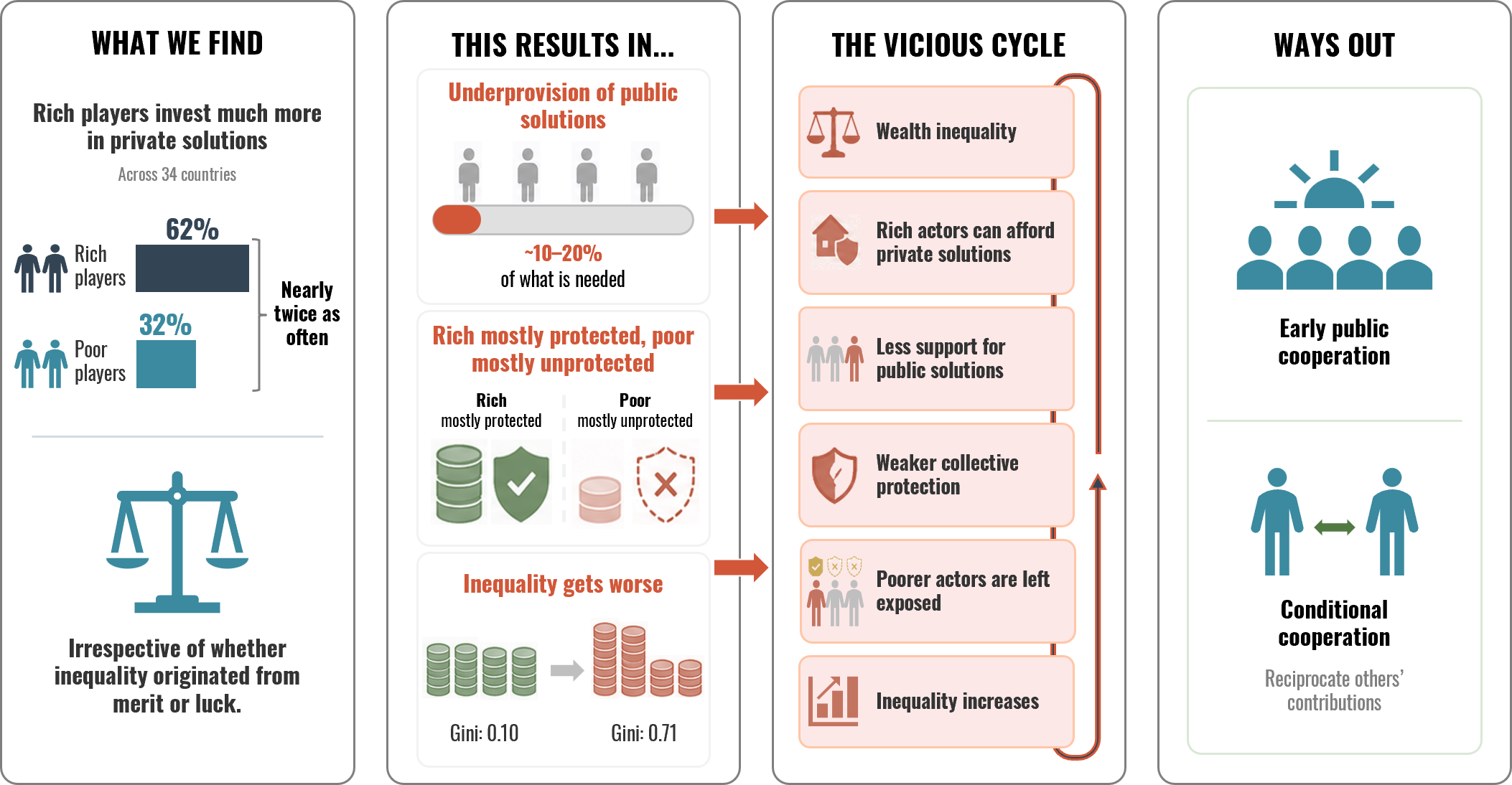
The consequences for inequality within groups were severe. Groups started the game with relatively low inequality (a Gini coefficient of 0.10, lower than could be found in the most egalitarian real economies). By the end, average inequality rose to 0.71, exceeding real-world levels in South Africa, one of the most unequal countries on earth. Poor players suffered the most: when groups failed to fund the public solution, poor players lost everything at more than five times the rate of rich players.
The issue that the origin of wealth did not matter goes beyond the lab. One common policy idea is to highlight that wealth differences, whether between people or countries, often come down to luck. The hope is that this will encourage wealthier people to support shared solutions. The experiment tested this. However, while the origin of inequality shaped fairness perceptions stated in a questionnaire, it did not change actual behavior in the game. Even when participants knew their wealth was random, they acted the same as those who thought they had earned it. Simply pointing out that inequality is based on luck is thus unlikely to change decisions, whether for a wealthy person choosing private health insurance or a rich country deciding between local and global climate action.
Culture Shapes the Trap – But Cannot Escape It
Cultural values also seemed to influence these patterns. Participants in cultures that, based on Schwartz’s value orientation scale, value harmony (living in balance with nature and others) provided more public solutions and used fewer private ones. Cultures scoring high on hierarchy and mastery did the opposite. For example, participants in Italy, Denmark, and some other European countries cooperated more, while those in the UK, Ghana, and China were more likely to choose private solutions.
However, no culture was immune to the private solution trap. In every country, richer participants opted out of public solutions more often. And in every country, wealth inequality rose over the course of the game. The trap is not only about individualism. It seems built into how inequality works.
Two Pathways Out
Even though the trap was pervasive, two types of behavior helped support public solutions in all 34 countries:
The first was early cooperation. Groups that invested more in the public solution right from the start were much more likely to succeed. Each extra unit given in the first round raised the chance of success by 11%, and this was true in every country. Early contributions seem to establish a cooperative norm before private solutions become common. Once people start choosing private options, it is much harder to change course.
The second was conditional cooperation – the tendency to match what others contribute. Groups with more people who responded to others’ public contributions had a 56% higher chance of success per conditional cooperator. This pattern was seen in 33 out of 34 countries.
Implications for Policymakers
The private solution trap can be seen in climate talks, global health decisions, and public services around the world. The findings suggest two ways to take action.
- Establish early commitments to public solutions before private options become popular by drawing on reciprocity. Global initiatives like climate clubs, where groups agree to work together on climate action, are one example. Another is matching commitment mechanisms, where one actor’s unconditional contribution triggers other actors’ previously declared matched conditional contributions. The main point is that timing matters: investing early in public solutions is especially effective and helps set the cooperative habits needed for future challenges.
- Keep in mind that the trap is structural. The private solution trap emerged in every country studied, including those with strong harmony values and more equal societies. Policies that narrow wealth gaps or make private alternatives less appealing may be more effective than simply encouraging shared values or pointing out that inequality is often due to mere luck, though those ideas remain important.
Reference
This opinion piece is based on the following paper:
- Malthouse, E., Pilgrim, C., Sgroi, D., Hills, T. et al. (2026). The private solution trap in collective action problems across 34 nations. Proceedings of the National Academy of Sciences, 123(12), e2504632123.
Further readings
- Gross, J., Veistola, S., De Dreu, C. K., Van Dijk, E. (2020). Self-reliance crowds out group cooperation and increases wealth inequality. Nature Communications, 11, 5161.
- Molina, C., Akçay, E., Dieckmann, U., Levin, S. A., & Rovenskaya, E. A. (2020). Combating climate change with matching-commitment agreements. Scientific reports, 10(1), 10251.
- Nordhaus, W. (2015). Climate clubs: Overcoming free-riding in international climate policy. American Economic Review, 105, 1339–1370.
- Schwartz, S. (2006). A theory of cultural value orientations: Explication and applications. Comparative Sociology, 5, 137–182.